
part one
The Guilt I Can’t Uncarry
The Breakdown That Shattered My Denial
Some awakenings come gently.
This one didn’t.
This one shattered me, on the side of a hockey rink, sitting on the cold concrete floor holding my son.
It was the last away game of the 2023 season.
Just me and my son this time.
I had started taking him to games myself.
Not because I suddenly had more time.
God knows, I was still juggling a toddler and trauma.
But something in me knew I couldn’t let him go without me anymore.
Not after everything I had started to piece together.
For most of the season, someone else took him.
Someone who had once stood in the role of stepfather.
It wasn’t safe.
Not emotionally.
Not psychologically.
And not for a sensitive, empathic kid who had spent years adapting to a home filled with tension, criticism, and control.
My son started his hockey journey full of passion and confidence.
He mastered the skill quickly and started changing teams, moving divisions.
His most successful year was with a middle-ranked division team.
He was a top scorer. Fearless. Creative.
The kind of kid who took the shot, every time.
But somewhere along the line, he stopped.
He became hesitant, looking for the assist instead of the goal, even if the net was wide open.
Set up perfectly for him, but he stopped taking the shot.
And I knew in my gut why.
It wasn’t a loss of skill.
It was a loss of safety.
He wasn’t playing for the love of it.
He was playing not to mess up.
Playing to please others as he learned love was conditional for some.
Playing to avoid criticism.
Playing small because being invisible was safer than being wrong.
Playing like he wanted to disappear.
The pressure even at this level became unbearable.
It only got worse when he joined an AAA Elite team.
Certain phrases burned themselves into him, at least the ones I can repeat here.
“You couldn’t score if you were inside the net.”
“What happened to you? You used to be good.”
“You played like a scared little girl.”
“Why am I wasting my time and money?”
It wasn’t feedback.
It wasn’t guidance.
It was demeaning, demoralizing, and designed to tear him down.
And it worked.
It got into his head until his fear of messing up became bigger than his love for the game.
When I tried to speak up, to express concerns, I was always dismissed.
Told I was too sensitive.
That I was babying him.
That I was the problem.
He is fine.
But he wasn’t, and I knew it.
So I reached out to others close to my son, hoping someone, anyone, could help me help him.
They spoke to the person causing the harm.
His main concern? Saving face.
He launched a smear campaign against me instead of taking accountability.
My feelings were dismissed again.
My truth not believed.
His lies were.
Mid-season, his talent was noticed by a top AAA Elite team in one of the hardest leagues in the nation.
A true honor.
But I was hesitant.
His confidence was already crumbling.
The pressure was unbearable.
I worried this would break him.
I voiced that concern, suggesting we stay committed to our current team for the rest of the season.
But it was dismissed.
Again.
Overruled.
So I supported him as best I could.
The travel became brutal.
Late practices. Full-day weekends.
I stayed home mostly with my toddler, and he went with someone I trusted.
Someone who promised to change.
I see now how wrong I was.
Every time he got home, I’d ask gently,
“How was the ride?”
“Did anything hurt your feelings or upset you?”
He’d always say, “It was fine”
Even when it wasn’t.
Maybe he didn’t tell me because he was protecting the other adult.
Or maybe because I had unintentionally taught him not to.
To stay silent.
To normalize dysfunction.
Or maybe…
He didn’t believe I could protect him because I couldn’t even protect myself.
Maybe he thought I was okay with it, since I kept sending him.
That thought breaks me.
The day that changed everything, I took him to an away game alone.
He seemed off.
I was taking team photos as usual when something in me said, Zoom in.
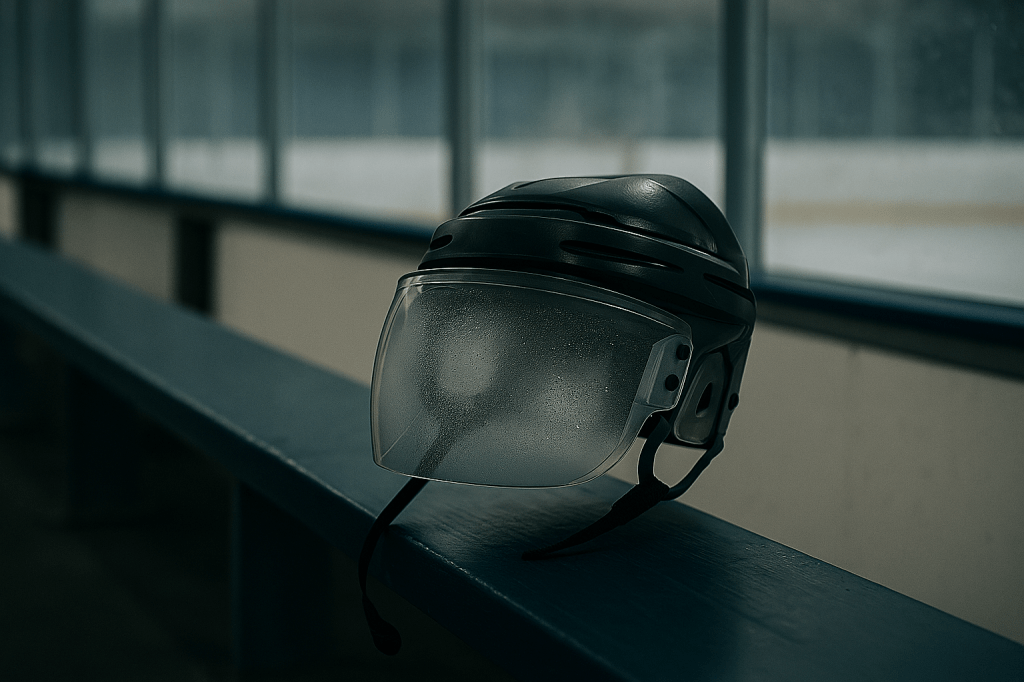
His helmet visor was fogged.
His face was red.
Tears streamed down his cheeks as he sat on the bench trying to stay composed.
I snapped the photo, instinctually.
It’s one of the most painful images I’ve ever taken.
I hung up my camera after that day.
Game ended. I waited outside the locker room.
He walked out pale, emotionally drained.
I asked quietly,
“Are you okay?”
And he just collapsed into my arms.
This wasn’t a bad day.
This was every unspoken moment.
Every bite of his tongue.
Every time he said he was fine when he wasn’t.
The noise of the rink disappeared.
I held him like I was trying to rewind time,
to undo every word that chipped away at him.
Every ride I wasn’t on.
Every silence I mistook for strength.
In that moment, everything clicked.
It wasn’t just hockey.
It was his fear.
His silence.
His shutdown.
My trauma had bled into his.
I held him tighter, trying to absorb his pain through my skin.
Pain I should have seen.
Pain I should have protected him from.
Pain I believed I caused because I let this man into our lives.
It hadn’t stopped, it had escalated.
This wasn’t just chipped confidence.
This was wounding.
Mentally.
Emotionally.
Psychologically.
This wasn’t tough love.
It wasn’t a disagreement.
This was abuse.
And I saw it.
Clearly.
Finally.
This wasn’t domestic violence.
It was family violence.
And in that moment, I drew a line in the sand.
I promised: This ends with me.
I started trusting my instincts.
I stopped waiting for someone else to validate what I knew in my bones.
I dove into learning about childhood trauma.
Nervous system development.
Attachment styles.
Emotional regulation.
The power of language and the long-term mental and physical health impacts of emotionally unsafe environments.
I unlearned everything I had been taught.
Because once I realized how deeply the emotional climate around a child shapes their self-worth,
I refused to keep the cycle going.
I wasn’t just raising kids anymore.
I was breaking generational patterns.
Because what hurt my son the most wasn’t just how he was treated,
it was the permission others gave by minimizing it, dismissing it, and refusing to call it what it was.
And I won’t ever be part of that silence again.
People love to say,
“Kids are resilient.”
As if that’s an excuse not to do better.
But resilience doesn’t mean unharmed.
It means they adapted.
They survived.
They internalized what they weren’t allowed to express.
“Resilient” shouldn’t be the goal.
Safe, supported, emotionally protected, that’s the goal.
Children shouldn’t have to be resilient just to survive the very people who are supposed to protect them.
I used to think I was protecting my kids by staying, being the human shield.
But this awakening showed me: they still got stung.
I wasn’t surviving for them.
I was surviving with them.
And I couldn’t protect them while staying in the place that was breaking me.
Staying “for the kids” isn’t safety if it teaches them love looks like fear and silence.
My parenting shifted completely.
From fear-based control to emotional connection.
From fixing behavior to understanding feelings.
From reacting to responding.
From surviving to healing together.
What we say, how we respond, how we discipline, how we show up… It all matters.
We’re writing the inner voice they’ll carry for the rest of their lives.
We’re teaching them how to navigate big emotions, stress, anger, sadness, fear.
Our actions and reactions become their blueprint for every future relationship, including the one they have with themselves.
I kept him close.
Present.
I created safety.
I made vulnerability sacred.
Because that breakdown?
It didn’t embarrass me.
It made me proud.
Proud of a boy who finally felt safe enough to fall apart.
And if he ever reads this someday…
Your pain woke me up.
Your tears shattered the silence.
Your honesty changed everything.
I carry an unbearable amount of guilt for not seeing it sooner.
Guilt that I didn’t speak louder.
That I let myself be silenced.
That I believed staying was safer.
This moment follows me into every EMDR therapy session.
Because no matter how unintentional it was, I still feel like I failed him. And it’s taken everything in me to work through the shame, the “should-haves,” and the weight of not knowing what I didn’t yet have the tools to see.
But I’m not staying in shame.
I’m breaking cycles.
In the end, turns out, I wasn’t the problem.
The moment he was gone, my son lit up again- confident, happy, thriving on the ice.
That wasn’t just a shift; it was proof
My instincts were never wrong.
⸻
Postscript:
This is my personal reflection, shared with care and intention. It is not meant to accuse or harm, but to shed light on the emotional experiences of children who grow up in unsafe environments—and the parents who wake up and choose to do better.
 Ashes & Ink